1. Application
Name the rooftop, ground-mount, shade, monitoring, or storage-adjacent context. If two contexts share one purchase, split the lines. Do not let a site nickname replace the electrical service.
Factory sourcing support for microinverter manufacturers
Buyer-side checklist
Use this list to see which lines are filled, which lines are open, and which files still have to be requested from a microinverter manufacturer. FluxBridge Procurement keeps the list as a buying worksheet. Checking a box here does not approve a design, a listing, or a shipment.
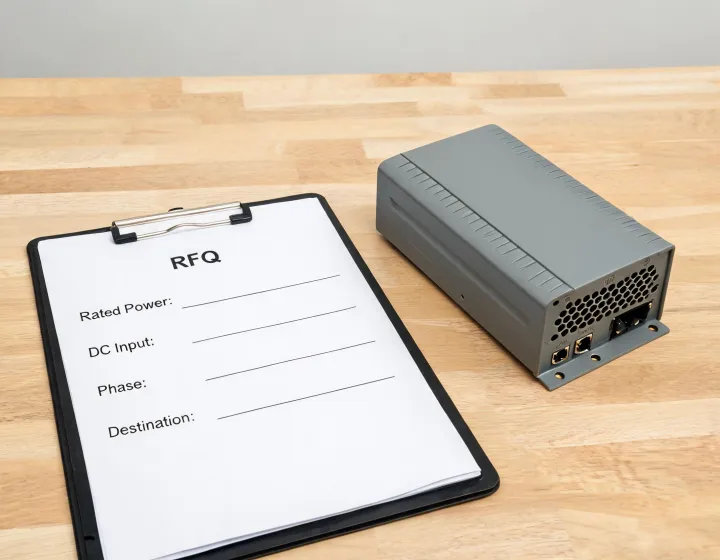
Name the rooftop, ground-mount, shade, monitoring, or storage-adjacent context. If two contexts share one purchase, split the lines. Do not let a site nickname replace the electrical service.
Write rated power, the DC input window, MPPT channels if the frame uses them, phase, and grid voltage. Maximum power voltage and open-circuit voltage of any included module go on the module line. A buyer might enter 350 W or 500 W, 22 V to 60 V, maximum power voltage 33 V, open-circuit voltage 41 V, module efficiency from the sheet, and 240 V or 480 V. Those figures are examples to replace, not a listed model.
Connector, trunk cable, mounting points, enclosure rating, and communication protocol. Say whether a gateway is in the buy. A protocol name without an owner still needs a sentence.
Request the datasheet and drawing for the quoted model. Add test, listing, or warranty files only as requests. A missing file stays missing until that supplier sends it.
Currency, included accessories, packaging, freight, tax or duty treatment, and exclusions. Optional budget with a per-unit or whole-order basis. Preference: premium, mid-range, budget-friendly, or not yet decided.
Module-level conversion can help where shade or monitoring is the reason for the architecture. A string layout can still be the right buy on a uniform plane. The checklist records which way the brief is leaning and who must confirm it. It does not score one architecture as the winner.
If storage is only a future note, leave AC-coupled versus DC-coupled unresolved. Asking a microinverter manufacturer to price a battery coupler that the reviewer has not chosen creates a quotation nobody can compare. Exclude that hardware until the line is real.
Grid-forming inverter behavior is a separate question from a grid-tied module-level unit. Write the question only when the project needs that behavior, and expect a yes, no, or not applicable against a model number. DC-to-AC ratio is a design figure. Copy it onto the RFQ only after the reviewer supplies it. Otherwise mark it open.
Deviations belong in a column of their own: rating, connector, protocol, accessories, or timing. An unmarked alternative is not an equal offer. Inspection method, sample need, and who signs acceptance stay outside the supplier price. The procurement brief carries a longer table. Labels and panel pairing feed the same worksheet.
For each proposed model, match the quotation identifier to the datasheet, dimensional drawing, and current listing record where required. Record the document revision and the reviewer's accepted, deviation, or open decision. If a sample is requested, agree cost and availability first; the qualified reviewer defines module voltage and current, grid conditions, operating temperature, measurement method, and acceptance limits. Record the model, firmware, and result. The checklist does not supply test data or authorize energized work.
Compare budget and service preferences through separate quotation columns: inverter price, trunk cables, gateway or monitoring charges, freight and taxes, warranty exclusions, and required documents. A lower equipment figure may fit a budget-led request; an offer including commissioning support or more documentation may suit another buyer. Normalize both to the same quantity and delivered scope before ranking them. Leave unavailable cost lines open and request clarification.
A complete brief is one that shows its gaps. Factories can quote an open field as to be confirmed. They cannot honestly quote a gap that was filled with a guess.
FREE sourcing support up to 3% follows the banner rule for qualified business buyers and is confirmed only after review of product, quantity, destination, and sourcing requirements. The checklist does not start a clock and does not reserve equipment.
Qualified business buyers
A confirmed benefit may be up to 3%.
Eligibility applies to qualified business buyers and is confirmed after we review your product, quantity, destination, and sourcing requirements.