Commercial rooftop
Application: several roof planes, possible walkway limits on trunk runs. Interface questions: connector gender, trunk-cable length, and who supplies the roof attachments. RFQ unit: inverters per plane, with spares listed apart.
Factory sourcing support for microinverter manufacturers
Application questions
The same watt label can sit on a shaded rooftop, a long ground-mount row, or a building that also has storage. FluxBridge Procurement, an independent sourcing partner, turns the use into fields a factory can answer. The desk does not select the architecture and does not report completed installations.
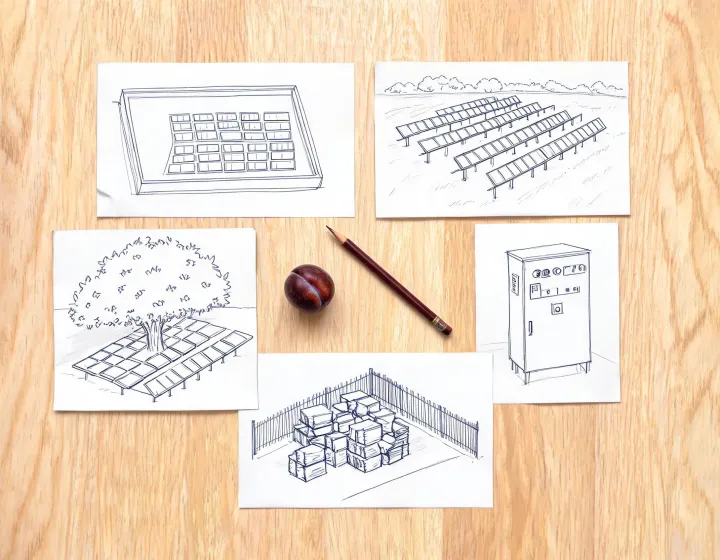
Each card is a prompt for the RFQ unit. None of them is a case study or a performance result.
Application: several roof planes, possible walkway limits on trunk runs. Interface questions: connector gender, trunk-cable length, and who supplies the roof attachments. RFQ unit: inverters per plane, with spares listed apart.
Application: long rows and a combiner or trunk home-run. Interface questions: row length versus cable rating, and the enclosure rating for the climate. RFQ unit: inverters per row plus the home-run hardware if it is in scope.
Application: trees, equipment screens, or mixed tilt. Interface questions: whether module-level conversion is required on every module or only on the shaded zone. RFQ unit: two quantities if the array is split between architectures. Engineering still chooses.
Application: a portfolio that wants module-level data. Interface questions: communication protocol, gateway ownership, and data interval. RFQ unit: power hardware on one line, communications hardware on another.
Application: PV that may later sit beside a battery, without assuming the coupling method. Interface questions: AC-coupled versus DC-coupled only as an open note, plus whether the inverter is grid-tied only. RFQ unit: the PV inverter line, with storage excluded unless the buyer adds it.
Rated power and the DC input window still have to be restated for the use. A rooftop and a ground-mount do not inherit each other numbers.
Count the units the use actually needs, including a spare policy if one exists. Do not copy a catalog carton quantity.
Packaging, freight to the US destination, and included cables change the offer. Write them beside the use so two factories describe the same arrival.
Ask solar microinverter manufacturers to bind the datasheet and drawing to the quoted model. Match the model identifier and document revision, then mark each requested rating accepted, a deviation, or unresolved. A use-case flyer is not that file.
Name the commercial, ground-mount, shade, monitoring, or storage-adjacent context, then the phase and grid voltage if they are known. Buyer-side examples, not catalog ratings, include rated power 350 W or 500 W, DC input 22 V to 60 V, maximum power voltage 33 V, open-circuit voltage 41 V, and service at 240 V or 480 V. The U.S. Department of Energy inverter overview frames architecture questions; it does not approve a proposed product. Leave coupling method and DC-to-AC ratio open when a reviewer has not closed them. Maximum power voltage of the module still belongs on the pairing page if a module is in the buy.
Before award, agree whether a sample or pilot is needed, who provides it, and who pays. The qualified reviewer sets the module and grid conditions, operating temperature, method, and acceptance limits before any energized test. Record model, firmware, measured voltage and current, and the result against that written plan; untested compatibility stays unresolved. Compare an equipment-only offer with an accessory-inclusive offer using the same quantity, currency, freight, taxes, warranty, and document scope. List missing cost lines and obtain written clarification before deciding which delivered total fits the budget.
The banner on this site describes FREE sourcing support up to 3% for qualified business buyers after the product, quantity, destination, and sourcing requirements are reviewed. The percentage is a ceiling on that support, not a discount printed on equipment.
Request Factory QuotesQualified business buyers
A confirmed benefit may be up to 3%.
Eligibility applies to qualified business buyers and is confirmed after we review your product, quantity, destination, and sourcing requirements.